
Sensory De-escalation: Connecting Somatic Awareness to Replacement Behaviors
Emotional regulation is not an innate trait; it is a neurological skill developed through consistent, structured co-regulation. For neurodivergent children (autism, ADHD, sensory processing disorders), emotional dysregulation is frequently triggered by interoceptive confusion—the inability to accurately identify physical internal states like elevated heart rate, muscle tension, or sensory overload.
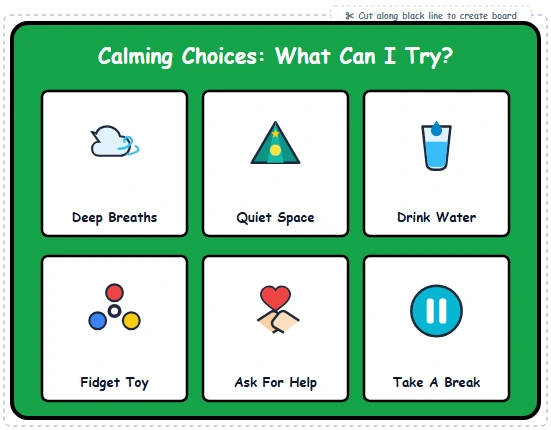
The Calm Down Regulation Board provides an externalized cognitive bridge. Instead of expecting a child in the red zone to articulate complex feelings in words, the two-part visual structure guides them through a two-step cognitive process: 1. Name the internal feeling state (I Feel: Overwhelmed), followed by 2. Select an approved replacement behavior (I Need: Deep Breaths or Quiet Space).
Validating the Emotion
All emotions are valid. By giving anger, sadness, and frustration a visible, respected space on the board, children learn that feelings are not bad or punishable—only unsafe actions require redirection.
Actionable Replacement Coping
Telling a dysregulated child to "calm down" gives zero instructions on *how* to calm down. Pairing the feeling with an actionable strategy (e.g. wall push-ups, sensory swing, drinking water) gives their nervous system an immediate physical outlet.
Step-by-Step Implementation Protocol for Sensory & Emotion Regulation
Teach During Calm, Baseline States
Never introduce a calm-down corner or board during an active crisis. Roleplay and rehearse selecting emotions and trying calming exercises (like starfish breathing or squeezing putty) when the learner is calm, playful, and receptive.
Co-Regulation Over Isolation
A calm-down corner is not a punitive "time-out". Sit calmly next to the child, model gentle breathing, and offer the board as a non-verbal communication tool: "I see your body feels tight. Let's look at what helps."
Validate the Sensation Before Moving Forward
Ensure the child feels heard. Once they place their "I Feel" card, affirm their feeling without judgment before encouraging them to select their calming coping tool.
Pairing Calming Boards with Communication Supports
Allowing learners to choose their own sensory reinforcers is critical for de-escalation; expand your coping options with a Visual Choice Board. For portable regulation cues during playground or cafeteria transitions, print a matching set of 2"×2" Pocket Cue Cards to keep emergency calming cards on your lanyard.
Classroom Fabrication & Sensory Safety Standards
Calm down boards and cards are often squeezed, folded, or swiped during acute emotional episodes. Ensure safety and structural resilience:
- Cardstock Weight: Print on 80lb–110lb heavy cardstock to prevent tearing and creasing during high-intensity emotional crises.
- Heavy 7mil Lamination: Use thick 7mil pouches to create flexible yet un-creaseable regulation cards that withstand squeezing.
- Soft Loop on Cards: Adhere rough hook Velcro to the board base and soft loop Velcro to card backs for a soothing tactile feel in the hand.
- Smooth Rounded Corners: Mandatory 4mm corner rounding on all cards and boards. Sharp plastic points can cause scratches during motor dysregulation.
Frequently Asked Questions: Calm Down Boards
Clinical guidance for teachers, speech therapists, and caregivers.
What is a Calm Down Corner board and how does it support emotional regulation?
A calm down board is a self-regulation visual tool that pairs an emotional check-in ('I Feel: Angry / Overwhelmed / Sad / Anxious') with an actionable, healthy replacement coping strategy ('I Need: Deep Breaths / Quiet Corner / Squeeze Ball / Drink Water'). It teaches children to recognize somatic arousal and independently initiate co-regulation or self-regulation routines.
Why do verbal questions ('What's wrong?') escalate meltdowns?
During high emotional dysregulation or sensory meltdowns, the amygdala hijacks cognitive processing, causing temporary speech and language processing deficits. Asking a dysregulated child open-ended verbal questions puts excessive pressure on their auditory centers. A visual board lets them point to their feeling and desired coping strategy with zero speech required.
How should a calm-down corner be introduced in a classroom?
Introduce the calm-down space and board during moments of calm, neutral emotion—never during a crisis. Model how to select feelings and practice calming strategies (like blowing bubbles or doing 5-finger breathing) when the child is already happy and regulated. This builds positive neural associations.
What are the four Zones of Regulation and how do they map to this board?
The Zones of Regulation framework categorizes alertness into four colors: Blue (low energy, sad, tired), Green (calm, focused, ready to learn), Yellow (elevated energy, frustrated, silly, anxious), and Red (extremely elevated, intense anger, out of control). Our builder allows color-coding borders to match these exact zones.
How do I make calm down cards durable enough for sensory biting or tactile squeezing?
For learners who bite or aggressively squeeze cards during emotional crises, we recommend 7mil thermal laminating pouches rather than 5mil, combined with rigid 110lb cardstock. Rounding corners with a 4mm punch eliminates sharp plastic needle-points that could scratch during dysregulation.
Can I use photos of our actual sensory corner equipment?
Yes! Click any card to upload photos of your classroom's specific weighted blanket, compression vest, noise-canceling headphones, or quiet teepee. Images stay 100% on your device with no cloud transmission, guaranteeing complete student privacy.