
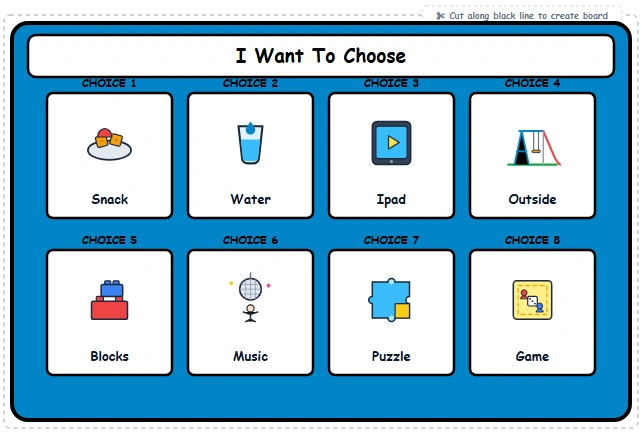
Structuring Decision-Making: Why Choice Boards Eliminate Frustration and Aggression
In speech-language pathology and behavior analysis, functional communication training (FCT) identifies that a substantial portion of challenging behaviors (screaming, throwing items, biting, or shutdown) stem from communication frustration. When an individual cannot vocalize what they want or feels completely controlled by an adult's agenda, behavioral escalation becomes the primary vehicle for expressing dissent.
A Visual Choice Board bridges this divide. By providing structured, concrete options, you eliminate open-ended verbal ambiguity ("What do you want to do?") which causes cognitive overwhelm. The learner can physically point, grab, or hand over their preferred card, exercising real agency over their environment.
Preventing Choice Overload
Neurodivergent children often experience executive dysfunction when faced with too many possibilities. Limiting options to 2–4 visually distinct choices creates a safe, predictable decision boundary.
Shared Control in Transitions
Even when a required task must be done, offering choices over the conditions (e.g., "Do you want to use the blue pencil or the green pencil?" or "Do you want to do math first or spelling first?") increases compliance by over 60%.
Step-by-Step Implementation Protocol for SLPs & Educators
Determine the Functional Field Size
Begin with a 2-choice field containing one motivating item and one neutral distractor. Once the learner reliably touches or hands over the card corresponding to their desired item, expand to 4 or 6 choices.
Model the Physical Exchange (PECS Protocol)
Guide the learner to pull the card from the Velcro coin and place it directly into the communication partner's hand. Pairing the physical exchange with the immediate item delivery reinforces that communication generates real results.
Honor Selections Unconditionally
Never override a student's visual selection with an adult preference. Honoring genuine choices—even unexpected ones—builds self-advocacy and confidence in AAC systems.
Combining Choice Boards with Transition & Regulation Tools
Use choice boards to offer options for the "THEN" reward slot on a First-Then Board, giving learners active ownership over their reinforcement. During emotional dysregulation or sensory overload, integrate choices directly with our Calm Down Regulation Board to let students select from approved coping strategies.
Classroom Fabrication & Heavy-Use Durability Standards
Because choice cards are constantly peeled off and handed to communication partners, fabrication must withstand heavy handling:
- Rigid Core: Print on 100lb or 110lb cardstock to ensure cards do not crease or wrinkle when grasped by learners with fine-motor differences.
- Thermal Lamination: Encase with 5mil or 7mil heavy-duty thermal laminating pouches to prevent peeling at coin margins.
- Hook & Loop Rules: Adhere rough hook Velcro coins to the board slots and soft loop Velcro coins to the back of cards to ensure comfort in the child's palm.
- Edge Safety: Round all card corners with a 4mm corner rounder punch to remove sharp plastic edges before clinical use.
Frequently Asked Questions: Choice Boards
Clinical guidance for teachers, speech therapists, and caregivers.
What is a Visual Choice Board and why is it essential for autonomy?
A visual choice board presents a curated selection of 2, 4, 6, or 8 visual cards allowing an individual to express preferences, request preferred reinforcers, or choose their next activity. For nonverbal, minimally verbal, or neurodivergent children, having structured visual choices fosters self-determination and dramatically reduces transition meltdowns caused by feeling powerless.
How many choices should I display at once?
When introducing a choice board to an emergent communicator or during times of sensory overload, begin with 2 distinct choices (one preferred and one non-preferred/neutral) to prevent choice paralysis. As the learner demonstrates consistent discrimination, expand to 4, 6, or 8 choices for snack time, play centers, learning stations, or regulation activities.
How does a choice board differ from a PECS communication binder?
A Picture Exchange Communication System (PECS) binder typically contains dozens of categorised symbols across multiple pages. A choice board is an immediate, situational display focused on a specific context (such as 'Snack Choices', 'Break Time Choices', or 'Math Station Choices'), reducing the cognitive search burden for the student.
Can I use real photographs of actual classroom toys or snacks?
Yes! Click any slot to upload photos of your student's specific preferred snacks (e.g., Goldfish crackers, apple slices) or exact sensory toys. Because emergent communicators often discriminate real objects before stylized icons, real photos speed up choice accuracy.
How do I format choice cards so non-speaking learners can pull them off easily?
Ensure you adhere soft 'loop' Velcro coins to the back of the 2"×2" cards and scratchy 'hook' Velcro to the board base. Using 0.75" Velcro coins leaves a comfortable edge border, allowing little fingers with fine-motor delays to gain leverage and pull cards without adult assistance.
How does a visual choice board integrate with a PECS communication exchange?
The 2"×2" choice cards match standard PECS Phase III dimensions. A student can physically remove their selected snack or activity card and place it onto a portable PECS sentence strip or hand it directly to a communication partner.