
Deconstructing Complex Motor Sequences: The Science of Visual Task Analysis
Daily living tasks that appear automatic to adults—such as brushing teeth, washing hands, or using the toilet—are in reality complex motor and sensory chains composed of numerous sub-skills. For children with developmental coordination disorder (dyspraxia), autism, or executive dysfunction, remembering the sequence while coordinating fine-motor actions creates significant cognitive fatigue.
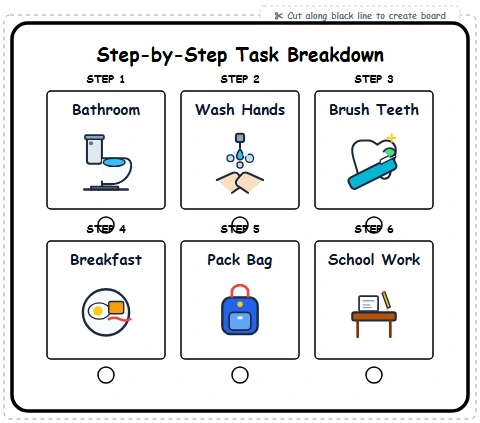
A Task Analysis Visual Schedule isolates each micro-action into an explicit visual anchor. Mounted directly in the functional environment (e.g., above the bathroom sink or inside the toilet stall), the board eliminates prompt dependency and guides the learner toward true independent mastery.
Numbered Step Badges
Numbered badges reinforce numerical order and directional tracking. The learner always knows exactly where they are in the sequence and how many steps remain until completion.
Checkmark Bubbles for Dry-Erase
Once laminated, the checkmark circles below each card can be marked with a dry-erase marker or covered with a Velcro star coin as each step is completed, providing immediate visual progress feedback.
Step-by-Step Implementation Protocol for Occupational Therapists & Educators
Isolate Discrete Observable Milestones
Ensure each card represents exactly one physical motion (e.g., "Turn on tap" vs "Soap"). Combining multiple demands on one card confuses emergent learners and hinders errorless learning.
Fade Prompts from Physical to Visual
Start with gentle hand-under-hand guidance through the routine while pointing to the board. As the learner anticipates the sequence, fade to a simple non-verbal gesture pointing to the next numbered bubble.
Pair with Tactile Dry-Erase Completion
Keep a fine-tip dry-erase marker attached to the board with a string. Encouraging the child to draw a checkmark or smiley face in the completion circle turns hygiene into an interactive game.
Connecting Task Analysis to Broader Schedules
Task analysis breaks down single discrete skills, whereas our Daily Routine Strip organizes the overarching chronological flow of an entire morning or evening. You can also print matching individual 2"×2" Pocket Cue Cards to keep on a portable lanyard ring for community outings.
Classroom Fabrication & Water-Resistant Durability Standards
Hygiene task analyses are frequently mounted near water, soap splatters, and humid bathrooms. Ensure waterproof resilience:
- Thermal Lamination: Use 5mil or 7mil heavy-duty thermal pouches. Ensure a 1/4" sealed plastic margin around all edges to prevent water seepage into the paper core.
- Cardstock Foundation: Print on 80lb–110lb bright white cardstock to guarantee symbol clarity and opacity against bathroom tiles.
- Waterproof Mounting: Use water-resistant mounting strips (such as outdoor foam tape or suction cup clips) to mount directly to mirrors or tile surfaces.
- Safety Corners: Punch all four corners with a 4mm corner rounder punch to remove sharp plastic edges before installation.
Frequently Asked Questions: Task Analysis
Clinical guidance for teachers, speech therapists, and caregivers.
What is Task Analysis in occupational therapy and special education?
Task analysis is the evidence-based method of breaking down a complex, multi-step life skill or daily routine (such as washing hands, using the toilet, or packing a backpack) into small, discrete, observable steps. Each micro-step is taught sequentially using forward chaining, backward chaining, or total task presentation.
How does a visual task analysis board accelerate potty training?
Potty training involves over six discrete physical and sensory transitions: entering the bathroom, pulling pants down, sitting on the toilet, wiping with toilet paper, pulling pants up, flushing, and washing hands. A visual task strip mounted at the child's eye level provides a permanent reference that removes performance anxiety and eliminates the need for constant parental verbal prompting.
What is the difference between forward chaining and backward chaining?
In forward chaining, the child learns Step 1 first and receives assistance for the rest of the chain. In backward chaining, the adult completes Steps 1 through 4, and the child performs the final Step 5 independently, immediately receiving the natural completion reward. Backward chaining is especially powerful for hygiene routines like hand washing.
How many steps should a task analysis contain?
Most pediatric occupational therapists recommend 4 to 6 steps for emergent self-care routines. Too few steps leaves out critical motor milestones (like turning off the water or using soap), while more than 7 steps can cause visual fatigue. Our builder allows toggling between 4, 5, or 6 steps.
How do I make a task analysis strip moisture-proof for bathroom sinks and showers?
Leave a 1/4" sealed plastic edge border when thermal laminating in 5mil or 7mil pouches before mounting with waterproof suction clips or bathroom adhesive strips. This hermetically seals the cardstock against sink splashes and shower humidity.
Can I use custom photographs for our student's specific bathroom fixtures?
Yes! Photographing the child's exact home sink faucets, foaming soap pump, or hand towel eliminates cognitive generalization hurdles for learners with significant cognitive support needs.